Types of Dachshunds: Sizes, Coats and Colors, From Your Lynchburg Groomer
I have been seeing more Dachshunds lately at my salon in Lynchburg. Owners often know their dog is a Dachshund, of course, but they are not always sure which type they have, especially when people use words like toy, tweenie, or rabbit.
For grooming, the coat and the dog's size matter much more than the label someone used when they adopted them. Color usually does not change the care at all. A coat does. A knot behind the back legs tells me more about a dog's week than any label on the paperwork.
Two sizes, not four
The AKC breed standard says Dachshunds are bred and shown in two sizes: standard and miniature. It says miniatures are not a separate classification, but compete in a class division for dogs 11 pounds and under at 12 months of age and older. People may use toy, tweenie, or rabbit informally for a dog below or between those sizes, but those words do not appear in the standard.
| Size | Weight | Height |
|---|---|---|
| Standard | 16 to 32 pounds | 8 to 9 inches |
| Miniature | 11 pounds and under | 5 to 6 inches |
The AKC breed page gives those height and weight ranges. The breed standard does not give a height. For me, a smaller dog may be easier to lift, but that does not mean they need a different kind of grooming. I still check the nails, ears, skin, coat, and body comfort on every Dachshund. Their long shape means I am mindful with every lift, no matter what size they are.
A standard Dachshund can take up more room across the table, and a miniature can be quick and wiggly. Both can be surprisingly strong when they decide they want to turn around and inspect what I am doing. Size changes handling and table time. It does not decide if a dog needs better brushing, a nail trim, or a good bath.
If your Dachshund is small, our small dog grooming service is set up for careful handling of little dogs.
Three coats need different care
The AKC breed standard names three coat varieties: smooth, wirehaired, and longhaired. This is the part that changes what you do at home.
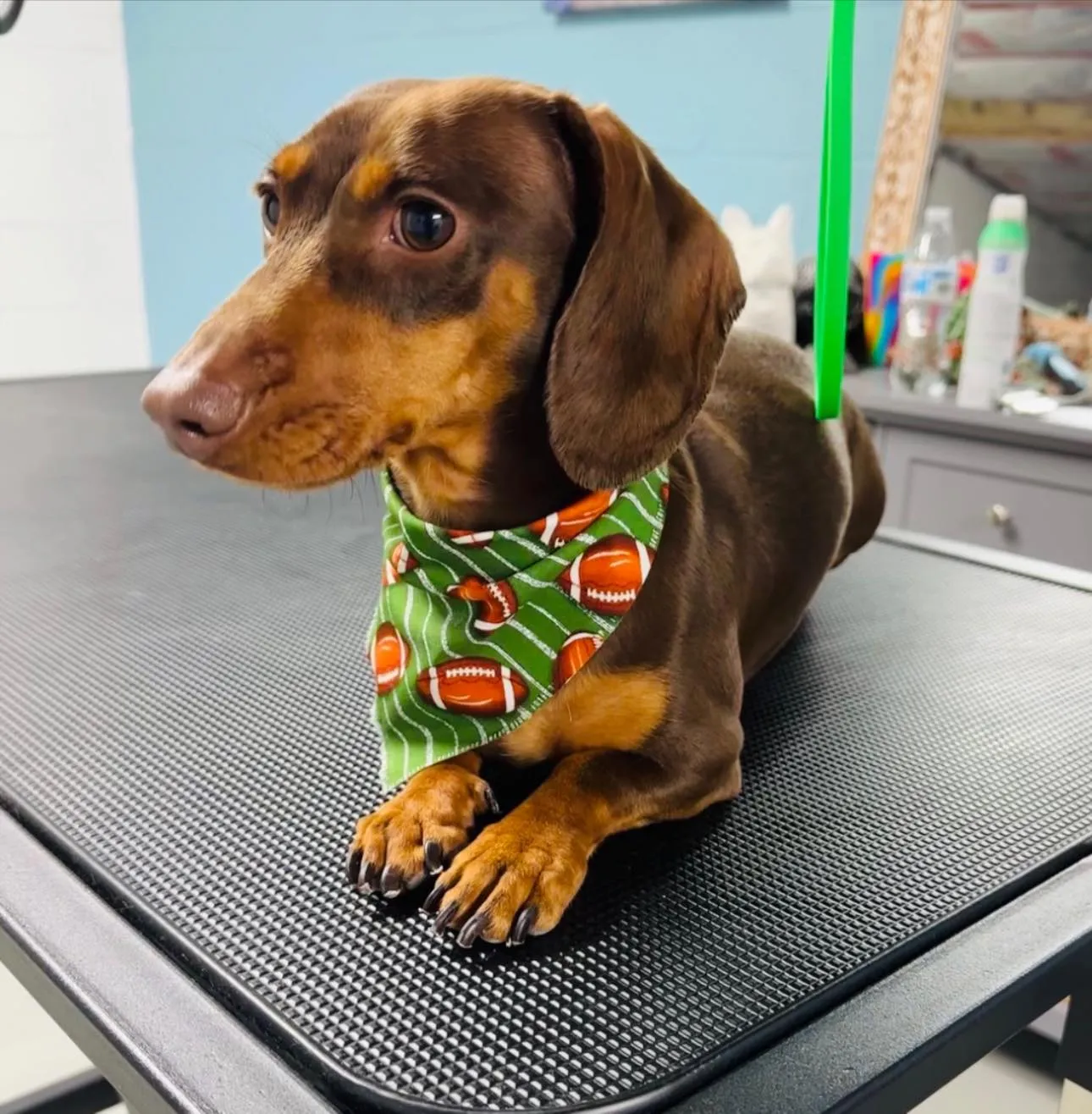
Smooth
The smooth coat is short, smooth, and shining. The standard says it should be neither too long nor too thick. A smooth Dachshund usually needs a bath, nail care, ear cleaning, and a good brush through. They still shed. Short hair fools people here. Run a rubber brush over the shoulders and the loose hairs come up anyway.
Short hair can hide loose hair near the neck, under the collar area, and along the chest. It can also make dry skin easier to notice. A good deshedding service can help remove what is already loose, but it will not turn a shedding dog into a non-shedding dog.
Smooth coats do not mat like long coats, but nails can still get too long between visits. Because Dachshunds stand so low to the ground, I pay close attention to how the feet sit. If you hear clicking on the kitchen floor, it is time for a nail trim.
Wirehaired
A wirehaired Dachshund has a tight, short, thick, rough, hard outer coat. Under that is a finer, softer, shorter undercoat. The AKC breed standard calls the absence of undercoat a fault. Wirehairs also have the facial furnishings people notice first: the beard and eyebrows. Their ear hair is shorter and almost smooth, and from a distance they can resemble a smooth Dachshund.
Up close, check the beard. Food, water, and little bits of dirt can collect there. I see it around the mouth and under the chin, especially if a dog has been drinking and then walking through grass or dust. The eyebrows can also get untidy enough to hang over the eyes.
I wash and tidy those areas without taking away the rough, bearded look that makes a wirehair recognizable. Ask about hand stripping versus clipping when you book. Those are different coat approaches. Groomers generally find that clipping softens that harsh texture over time. The breed standard describes the coat, but it does not mention trimming or stripping.
Wire coats can also hold a soft undercoat close to the skin. So I part the hair with my fingers and look underneath before I decide anything. A coat can look rough and neat on top while loose undercoat is sitting underneath.
Longhaired
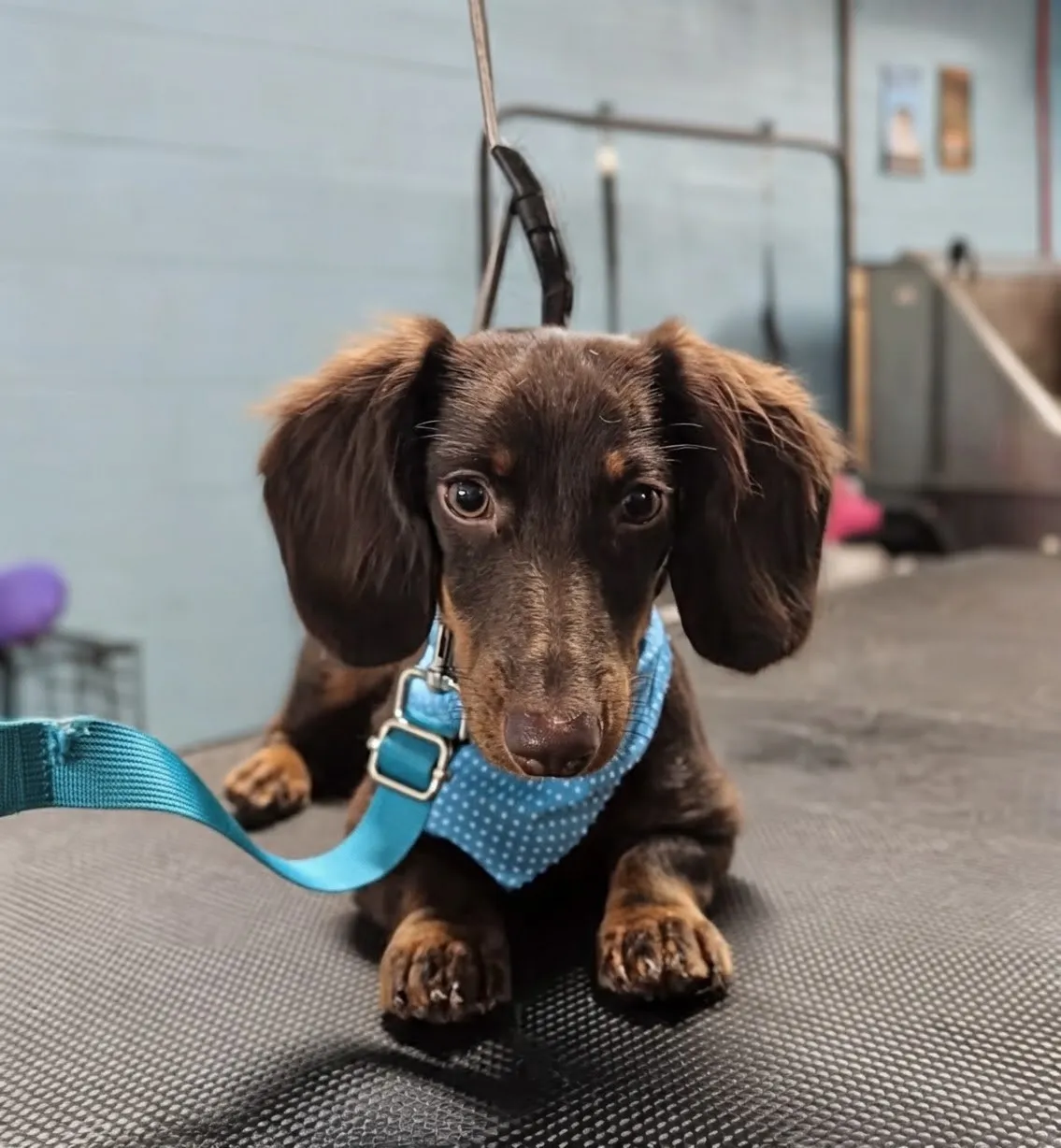
The longhaired Dachshund has a sleek, glistening coat that is often slightly wavy. The longer hair is under the neck, on the forechest, underside, ears, and behind the legs. The tail hair is longest and forms what the standard calls a veritable flag.
For long haired Dachshund grooming, those feathered areas are where tangles begin. Under the neck, chest, belly, ear fringes, behind the legs, and the tail flag all catch friction. I find knots where a harness rubs, in the soft hair behind the elbows, and under the belly where wet grass and dirt can cling.
At home, line brush to the skin. That means separating a small section of hair and brushing from the skin outward instead of brushing only the surface. A top layer can look lovely while a tight mat is sitting underneath it. If mats are already packed in, a dematting appointment may be needed, depending on what is safe and comfortable for the dog.
The standard lists a curly coat or a coat that is too profuse as faults, along with hair equally long over the whole body and a pronounced parting down the back. So I aim for a tidy trim that keeps the feathering, and I leave the shave-down for a coat that is too matted to save.
Colors and patterns do not decide the haircut
Dachshund colors can sound complicated because color and pattern are often discussed together. The AKC breed standard lists the groups below. The AKC registration system also keeps its own list of colors, including Black and Cream, Black and Tan, Blue and Cream, Blue and Tan, Chocolate and Cream, Chocolate and Tan, Cream, Fawn (Isabella) and Cream, Fawn (Isabella) and Tan, Red, Wheaten, and Wild Boar. Its registration markings include Brindle, Dapple, Piebald, and Sable.
| Group | What the standard lists |
|---|---|
| One-colored | Red and cream, with or without shading of interspersed dark hairs. |
| Two-colored | Black, chocolate, wild boar, gray (blue), and fawn (Isabella), each with deep rich tan or cream markings. |
| Dapple (merle) | Lighter areas contrast with a darker base. |
| Brindle | Black or dark stripes over the entire body. |
| Piebald | Clearly defined white patches on an allowed one-colored or two-colored dog. |
| Sable | A uniform dark overlay on red dogs. |
| Wild boar | Individual hairs are banded, making a grizzled effect, most often on wirehaired Dachshunds. |
The standard says colors or patterns other than those specified are a disqualification. That rule belongs to the show ring. On my table, a red, black and tan, dapple, or piebald Dachshund gets the haircut and coat care their coat type needs.
Color does make one practical difference sometimes. Light cream coats can show staining around the beard and eyes more clearly. The dog may not be dirtier than a darker dog. You can simply see it sooner. I clean gently around those areas and look at the skin instead of trying to make a light coat look unrealistically white.
Double dapple needs extra handling awareness
The AKC merle article by Caroline Coile, PhD, explains that a double dapple has two merle genes and may not look like a typical merle. It says two M genes greatly increase the chance of deafness, depending on the breed, and double-merle dogs often have microphthalmia, or abnormally small eyes. If a dog may not hear or see well, I approach from the front, move slowly, and touch the dog before bringing tools close.
The long back needs care on the grooming table
Dachshunds are known for their long backs, and that matters during grooming. Cornell University College of Veterinary Medicine says the American College of Veterinary Surgeons estimates Dachshunds alone account for 40 to 75% of all IVDD cases.
Cornell's advice is practical: keep the dog trim and fit, minimize stairs and jumping on and off a deck, bed, or sofa, and use steps or ramps to reduce jumping. In Cornell's words, "Walking is safe for any dog. Leaping for a thrown toy, not so much." I think owners sometimes focus on the big jump from the sofa and miss the smaller repeated jumps through the day.
At the salon, I support the chest and hindquarters together when lifting a Dachshund. I never let them jump off the grooming table. I also keep nails short because long nails are uncomfortable on a low stance. If your dog has a back history, please mention it before grooming starts. That helps me handle them with the extra care they need.
Older dogs and dogs with mobility changes may need more breaks and gentler positioning. You can read more about our senior dog grooming approach if your Dachshund is slowing down or seems less steady than before.
How often each type needs a groomer
My usual recommendation for a smooth Dachshund is a bath and nails every 4 to 8 weeks. They may not need much coat shaping, but regular care keeps loose hair, skin buildup, ears, and nails from becoming bigger jobs.
For longhaired and wirehaired Dachshunds, I usually recommend grooming every 4 to 6 weeks, plus home brushing a few times a week. Long coats need more brushing around the feathering. Wire coats need attention around the beard, eyebrows, and undercoat. Your dog's actual routine may shift with their lifestyle, coat condition, and how much brushing happens at home.
If your dog gets worried with grooming, tell me. A quiet, one-dog setting can help, and our anxious dog grooming information explains how I work with dogs that need a slower approach. You can also review how often to groom your dog when you are trying to build a regular schedule.
When you book, tell me the coat type, any back history, and where the tangles are starting: beard, ears, belly, or tail. I trained as a groomer in Colombia, I work with one dog in the salon at a time with no cages, and I can do the whole appointment in English or Spanish. Clients bring their Dachshunds to Lynchburg from Forest, Bedford, Madison Heights, and Amherst. Tonight, run your fingers under the tail or through the beard. If they catch, mention it when you call.